
File It or Lose It: Organizing Your Undress Results So You Can Find Them Again (2026)
Kiire otsus: An undress result you cannot find is a result you paid for twice. The fix is boring and it works: name every file the day you make it, sort by one rule you never break, and keep a short note with each keeper. Most people do not need a better filing app. They need a naming habit that survives a month of generating, because the rule is simple — file it or lose it.
Contents:
- 1. Why Undress Results Get Lost
- 2. Four Ways to Sort, Compared
- 3. Name It the Day You Make It
- 4. The Folder System That Survives a Month
- 5. Find It Again in Ten Seconds
- 6. What It Costs
- 7. Honest Limitations
- 8. Who This Is For
- 9. Consent and Safety
- 10. KKK
1. Why Undress Results Get Lost
An undress costs 21 credits and about a minute. A month of casual generating produces fifty or a hundred results, and by then the problem is no longer generating. It is finding. The file you loved on Tuesday is buried under forty files named like output_20261113_091234.jpg, and the only way to identify it is to open each one and look. Most people give up at the fifth file and generate the result again instead. That is the hidden tax on a disorganized library: you pay twice for the same image because you could not find the first copy.
2. Four Ways to Sort, Compared
Every filing system picks one question to answer first: when was it made, what did it come from, what is it for, or how good is it? Sort by only one. The moment a system tries to answer two questions at once, it collapses into folders inside folders and nobody maintains it.
| Sort by | Best when | Mis murrab | Effort per file |
|---|---|---|---|
| Date | You generate daily and want a timeline | Finding one result among hundreds of dates | None — the date is automatic |
| Input photo | You re-run the same photo many times | Results from many different photos scatter | Seconds — copy the input name |
| Use | Results have clear jobs: avatar, video frame, archive | One result fits two uses and lives nowhere | Seconds — pick one use per file |
| Quality | You keep only the best and delete the rest | Judging quality takes a second look at every file | A minute — you must look and decide |
Date is the default because it costs nothing, but a date tells you nothing about the image, and a library sorted only by date is a library you can only search by remembering when you made something. That works for a week and fails for a month. Use is the most useful for people who actually do something with their results, because it answers the question you ask when you open the folder: what is this one for? The practical answer is a hybrid with one rule: sort by use first, and let the date live inside the filename. A file called 2026-11-13_avatar_blue-dress_v2.jpg carries its date, its job and its version in one line, and it sits in a folder called avatars where you can find it without remembering the date.
Quality sorting deserves a warning. It is tempting to keep a folder called best and move winners into it. The trouble is that quality is a judgment, and judgments change: a result that looked average on Tuesday can look like the best one on Friday once you have seen twenty worse ones. Use quality as a tag inside the name — _keep or _best — and let use or date do the sorting. A tag is easy to change. A folder structure is not.
3. Name It the Day You Make It
Naming is the whole system. A folder tree without names is a set of empty boxes, and a name written a month later is a guess. Name the file within a minute of downloading it. The name has four parts, always in the same order: date, use, source, version.
The date goes first because dates sort themselves. Files named 2026-11-13_…, 2026-11-14_… and 2026-11-15_… fall into chronological order in every file manager, with no effort at all. If the date goes last, the files sort by use first and the timeline is lost.
The use goes second, and it should be one short word: avatar, video, compare, archive, test. If you need two words to describe the use, you have not decided what the file is for. A file with two uses gets the use you will reach for first.
The source goes third: a short tag for the input photo, like blue-dress or window-light. When a result is good and you want a variation, the source tag is what lets you find the input photo again in seconds instead of scrolling through your camera roll.
Version goes last, and it is the smallest part with the biggest payoff. You generate three versions and keep one; without a version number, the three files have three unrelated names and you cannot tell which one is the keeper. With _v1, _v2 and _v3, the keeper is the highest number you kept, and the rest can be deleted without a second look. And never let a file keep the name the generator gave it: output_20261113_091234.jpg holds a date and a time, but no use, no source and no version.
4. The Folder System That Survives a Month
Folders should be few, flat and named after uses. Five folders cover almost everyone: avatars, video-frames, comparisons, tests and archive. That is the whole tree. No subfolders inside them, no folders by month, no folders by model. A flat tree is a tree you can see at a glance.
The five folders have different jobs. Avatars holds results that will be used as a profile picture or a character image. Video-frames holds stills you intend to animate. Comparisons holds pairs and sets: the same input run five ways, or the same pose with different light. Tests holds experiments — a new setting, a new input type, a prompt you tried once. Archive holds everything you are not ready to delete but do not need to see. Anything else goes in the archive, which is allowed to be messy.
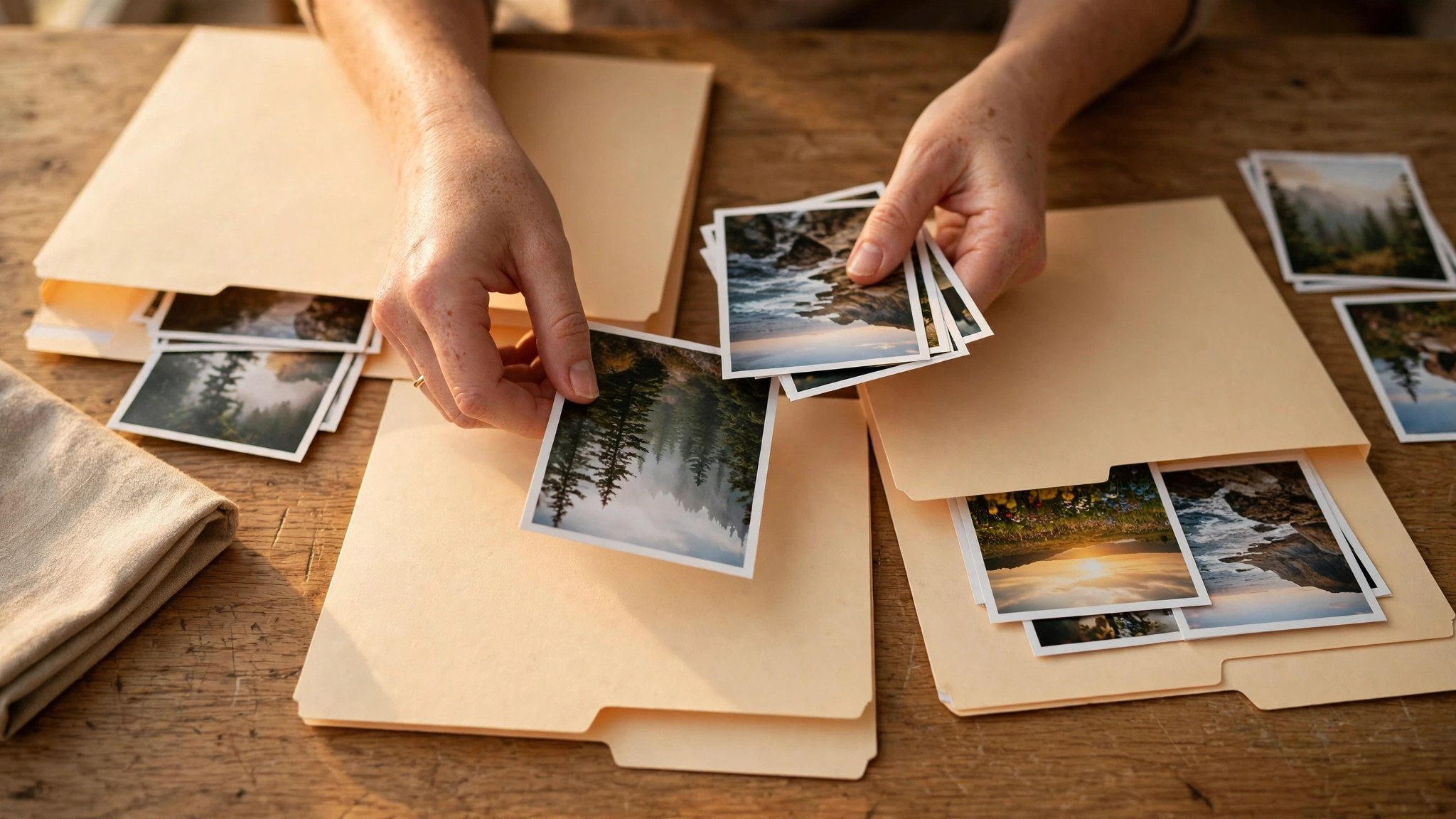
The system works because the folders match the questions you ask. When you want an avatar, you open avatars. When you want to animate something, you open video-frames. And when a folder gets too full to scan, the fix is not a subfolder. It is a cleanup: move the files you have not opened in a month into archive, and delete the duplicates.
Keep the tree in one place. Results scattered across a downloads folder, a desktop folder and a cloud drive are three libraries, and three libraries are no library. Pick one root folder, put the five folders inside it, and point every download at it. Finally, keep a one-page note in the root folder: a plain text file called readme.txt with three lines per keeper — the filename, one sentence about why it was kept, and the input photo it came from. The note is the memory the files do not have.
5. Find It Again in Ten Seconds
Finding is the test of the whole system. If you cannot find a keeper in ten seconds, the system has failed, no matter how tidy the folders look. The test has three parts. First, search by use: open the folder for the job — avatars, video-frames — and you have already cut the library to a fifth of its size. Teine, search by date: type 2026-11-1 into your file manager’s search box and the results narrow to that week. Kolmas, search by source tag: if you remember the input photo — the blue dress, the window light — type the tag and the file appears. Any one of the three usually suffices. Two of them together are close to certain.

The habit that makes this work is the weekly five-minute review. Once a week, open the downloads folder, rename anything that arrived without a name, move each file into its use folder, and delete the versions you did not keep. Five minutes a week is less time than one failed search.
There is one more habit worth building: delete on purpose. A library that only grows is a library that gets slower to search. When you keep a new version of a result, delete the old version in the same minute. Deletion is not loss; it is the thing that keeps the keepers findable.
6. What It Costs
Hinnad kontrollitud 13 nov 2026. Only the numbers below are used in this article; they are the platform’s published credit prices.
An undress result costs 21 krediidid. Filing it costs nothing: renaming a file, moving it into a folder and writing one line in a text note are free. The cost of this system is therefore measured in what it saves, not what it spends. Five undresses filed the day they are made cost 105 credits — $2.10 at the $19.99 Pakett ($0.020 per credit) or $1.26 at the $59.99 Pakett ($0.012 per credit) — and every one of them stays findable. Five undresses left unnamed and regenerated later because the first copies could not be found cost 210 krediidid: $4.20 or $2.52.
The packs themselves: $19.99 buys 1,000 credits and $59.99 buys 5,000 krediidid, both one-time purchases with instant credit. The annual packs are $119.88 and $359.88, paid once and delivered monthly across 12 months. There is no auto-renewal wording on these packs, and no $199 pack exists yet. A single standard text-to-image generation costs 6 krediidid; an image-to-image or template generation costs 49 krediidid; a face swap costs 26 krediidid; a 5-second video template costs 351 credits and an 8-second one costs 561 krediidid.
7. Honest Limitations
A filing system cannot fix a bad result, and it cannot make a result you deleted come back. If you delete the only copy of a keeper, the name and the note will tell you exactly what you lost, which is small comfort. The system also cannot protect results from the platform’s own deletion rules: uploads are deleted 24 hours after upload once all referencing tasks have finished, so the library on your disk is the only library that matters.
There is also a limit to how much structure helps. A library of twenty files needs no system at all, and a library of two thousand files needs more than folders — it needs tags, and probably a tool built for the job. This system is sized for the middle: a few dozen to a few hundred results, generated over weeks and months, by one person.
Finally, no naming scheme survives a change of habit. If you stop naming files for two weeks, the library does not stay organized — it starts rotting from the newest files backwards. The system is a habit, not a setup. The setup takes ten minutes. The habit takes a month, and the weekly five-minute review exists precisely for week three, when the novelty wears off and the downloads folder fills up again.
8. Who This Is For
This system is for you if you generate regularly — a few results a week, over months — and you have already felt the sting of regenerating something you know you made once. It is for you if your results have jobs: an avatar, a video first frame, a comparison set, a character you return to.
Skip it if you generate once, look at the result, and never need it again. A single undress does not need a library, and a naming scheme for one file is paperwork for its own sake. Skip it, too, if you would rather spend 21 credits than thirty seconds naming a file.
9. Consent and Safety
Only file undress results of yourself or of fictional adults you created. Never keep, name or organize an undress of a real person who did not agree to it, and never keep an image of a minor — real or realistic — under any circumstances. A named, sorted library is easier to keep, find and share — which is exactly why it must only hold material you have a right to keep.
Keep the library private. Store it on a device you control, in a folder that is not synced to a shared account, and do not let a cloud service back it up to an account someone else can open. If a result is sensitive, the archive folder is not private enough — encrypt the volume, or delete the file.
10. KKK
What is the simplest filing system that actually works?
Five flat folders named by use — avatars, video-frames, comparisons, tests, archive — and filenames in the order date, use, source, version. Rename each file the day you make it, move it into its use folder, and write one line about it in a readme note.
Should I sort by date or by use?
By use first, with the date inside the filename. A folder answers the use question and the name answers the date question. Date-only sorting fails after a month, because you will not remember which week a result came from.
How do I name a file so I can find it later?
Use four parts in a fixed order: date, use, source, version — for example 2026-11-13_avatar_blue-dress_v2.jpg. The date first makes files sort chronologically on their own. The source tag connects the result back to the input photo,
What do I do with results I am not ready to delete?
Put them in the archive folder and stop thinking about them. The archive is allowed to be messy — that is its job.
How much time does filing take per result?
About thirty seconds: rename the file, move it into its folder, write one line in the readme note. Thirty seconds per file is cheaper than one re-run at 21 krediidid.
Is it safe to keep undress results in a folder at all?
Only if the folder is private and the results are yours or fictional adults you created. Keep the library on a device you control, do not sync it to a shared account, Never keep an undress of a real person without their agreement, and never keep an image of a minor.
Loe edasi:
- Lahtiriietumine, Then Animate: Turning Your Still Into a Moving Clip
- Change the Room, Not the Body: Editing the Background After an Undress
- Light Is the Input: How Indoor, Outdoor & Flash Photos Change Your Undress Result
Undress results start on the Tehisintellekti lahtiriietumine page; video templates live on the Tehisintellekti pornovideogeneraator page. Face work, if you need it, is on the AI Image Face Swap page, and finished images are easy to find again in the Galerii.


Jäta kommentaar