
Light Is the Input: How Indoor, Outdoor & Flash Photos Change Your Undress Result (2026)
Contents
- 1. What “light is the input” actually means
- 2. Indoor light: window, lamp, and overhead
- 3. Outdoor light: sun, shade, and overcast
- 4. Flash and backlight: the two problem lights
- 5. The ten-second light test before you generate
- 6. Combien ça coûte
- 7. Honest limitations
- 8. Consentement: the line that does not move
- 9. FAQ
1. What “light is the input” actually means
An undress model is not a light designer. It does not decide where the sun was, add a window that was never there, or rescue a face shot in the dark. It reads the light in the photo you upload and carries it across: the bright side stays bright, the shadow side stays dark, the direction stays the same. Clear light in, clear light out. Confused light in, confused light out — a torso lit from the left with a face lit from the right, a shadow falling the wrong way, a body that looks pasted onto a room it was never in.
Fix the light before you generate, Pas après: a second generation starts from the same broken light and fails the same way. A retaken photo costs nothing; a regeneration costs 21 crédits. This guide covers the four light situations you will actually meet — indoor, outdoor, flash, and backlight — plus a ten-second test to run before you spend a credit. It assumes you are undressing photos of yourself, or of fictional adult characters you created, on Nudify AI’s undress tool. La règle du consentement est absolue, and it is covered in section 8.
| Lumière | What the model sees | What usually goes wrong | Verdict |
|---|---|---|---|
| Window daylight | One source, clear direction, soft falloff | Very little — the safest input | Use it |
| Overhead room light | Flat, Uniforme, directionless | Flat body, no depth, washed-out skin | Usable, but dull |
| Outdoor sun | Hard shadows, strong contrast | Blown highlights, black shadow side | Good in shade, risky at noon |
| Overcast sky | Doux, Uniforme, shadowless | Too flat — like overhead, but prettier | Good for skin, weak for form |
| Direct flash | Harsh front light, hard shadow behind | Flat face, red eye, cut-out look | Avoid |
| Backlight | Bright background, dark subject | Silhouette, lost detail, guessed anatomy | Avoid unless exposed for the subject |
2. Indoor light: window, lamp, and overhead
Indoor photos split into three very different lights. The window is the best of them: a large, soft source with a single direction — a studio softbox you did not have to buy. Stand the subject a metre or two from the window, with the window to one side, and the light wraps the body with a clear bright side and shadow side. The model reads that easily.
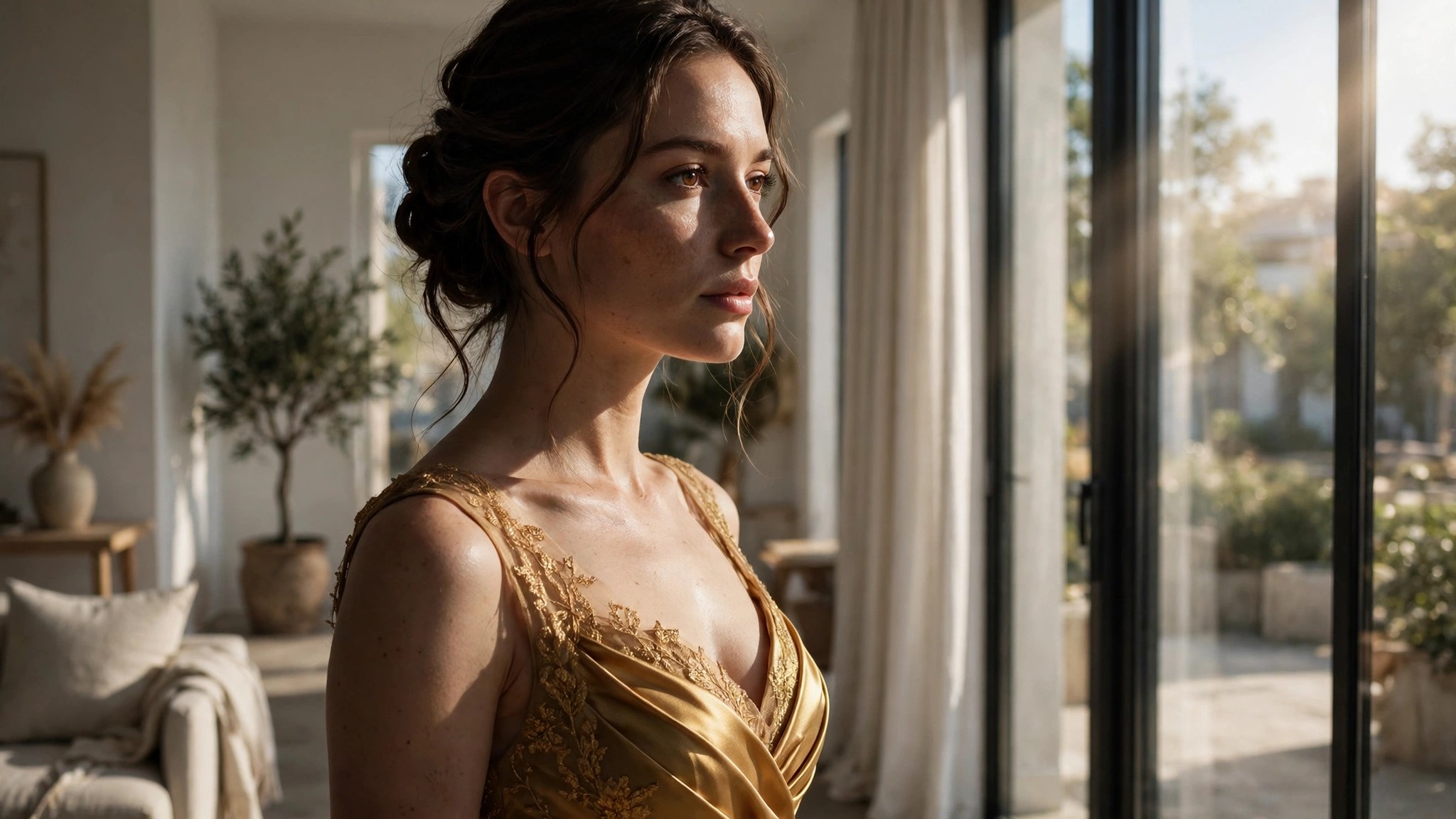
A lamp is a mixed case. A single warm lamp gives the photo a mood — amber skin, deep shadows — and the model handles it well, because the light still has one source and one direction. The trouble starts with two lamps, or a lamp plus a television: every extra source adds a second set of shadows, and the result has shadows pointing in two directions. If you shoot with a lamp, turn the other lights off.
Overhead room light — the ceiling fixture, the kitchen downlight — is the worst indoor light, and also the most common. It is flat, Uniforme, and directionless: it lights the top of the head and shoulders and leaves everything else the same grey. With no bright side and no shadow side, the model has no information about the shape of the body, so the result looks flat because the input was flat. An overhead-lit undress is rarely terrible, which is the trap: it is just dull, and dull is easy to mistake for acceptable.
3. Outdoor light: sun, shade, and overcast
Outdoor light is stronger than indoor light, and stronger light means stronger mistakes. Direct sun at midday blows out the bright side to pure white and crushes the shadow side to near black, and the model has to invent everything in between. Skin loses its texture in the glare, and the result looks waxy. A midday sun photo can work, but it is a gamble, and the house wins more often than you do.
Shade is the outdoor equivalent of window light, and the best outdoor input. In open shade — under a tree, or on the shady side of a building — the light is soft, directional, and even. The sky becomes a giant softbox, and the model gets the same clean information it gets from a window. A shaded outdoor photo is often better than an indoor one, because the light is stronger and cleaner, and the skin keeps its texture. Golden hour is the one exception worth naming: warm, low, directional light that shows form beautifully, but it lasts minutes, so shoot fast — a face perfectly lit at 6:00 can be a silhouette at 6:15.
Overcast sky is the softest outdoor light, and it has the same weakness as overhead room light: no direction. An overcast photo has beautiful, even skin and almost no shadows, so the model cannot tell where the body curves. The result is pretty and flat — a good input for a face, a mediocre one for a body, because a body needs shadows to read as a body. On an overcast day, put the subject near a wall or a tree so one side of the body is slightly darker than the other. A little direction is worth more than perfect softness.
4. Flash and backlight: the two problem lights
Direct flash is the worst light in this guide. A phone flash fires from the same position as the lens, so the light hits the subject dead-on, flattens every curve, and throws a hard shadow directly behind them: bright face, dark background, no depth. With no shadows to show where one surface ends and another begins, the model guesses the anatomy, and its guesses are visible. If your only photo was taken with flash, take it again without flash — stand near a window, or step outside into shade. Do not try to fix a flash photo with a second generation: the flash is baked into the input, and light is the input.
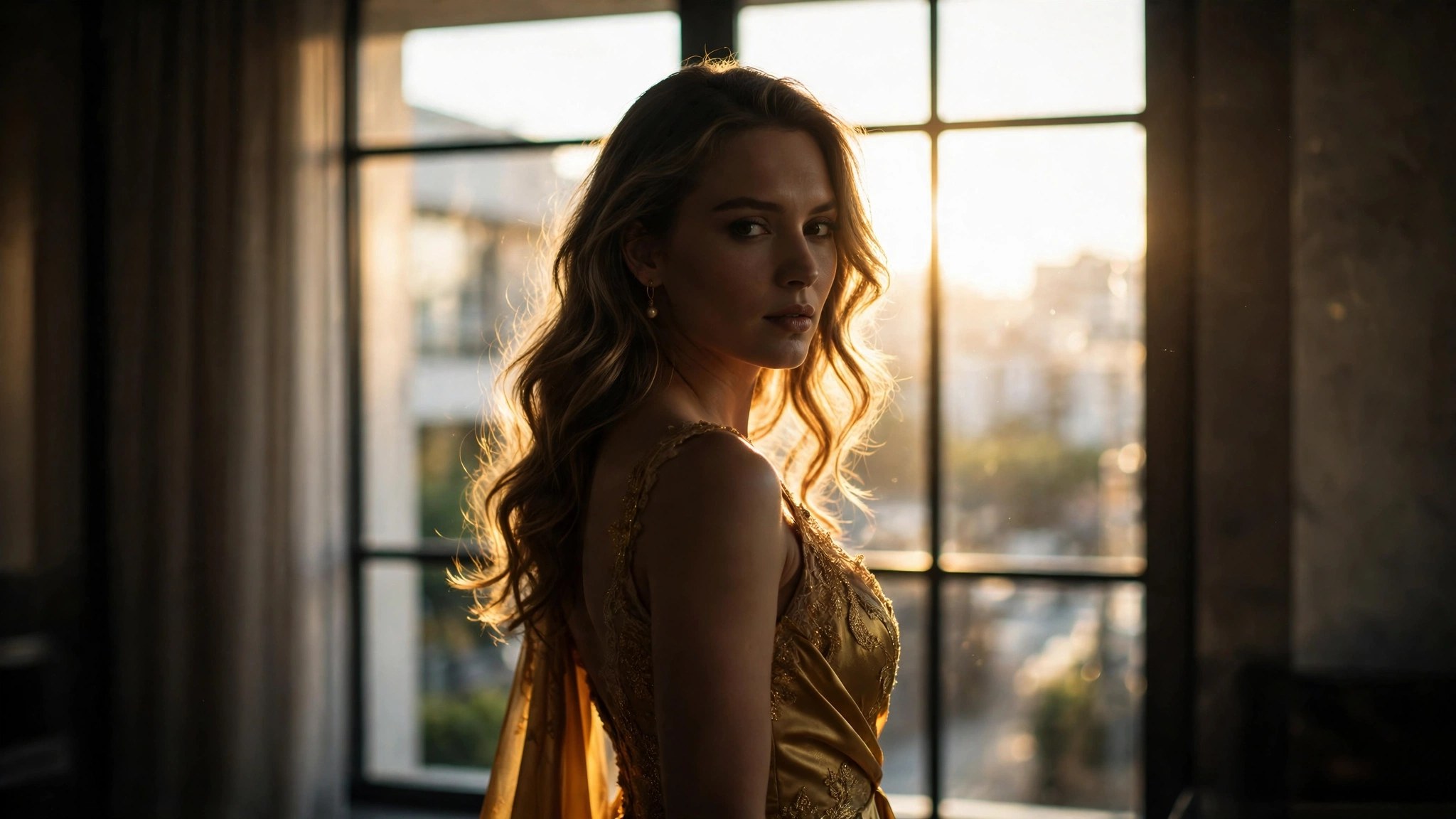
Backlight fails in the opposite way. The light comes from behind the subject, so the background is bright and the subject is dark, and the camera usually exposes for the background, turning the subject into a silhouette: a dark shape with a bright rim and no visible detail. The model then has to invent the entire front of the body from almost no information, and what it invents is generic — the one thing a good undress must not be.
One backlit case works: when the camera exposes for the subject, not the background — the background blows out to white, but the subject is properly lit. You can tell by the face: if you can see the eyes and skin tone, the photo is usable; if the face is a dark mask with a bright rim, it is not. Both problem lights share one lesson: the camera’s automatic settings are not your friend. Before you shoot, tap the subject’s face to lock exposure on the person, and turn the flash off. Two taps, and the light is the input you actually want.
5. The ten-second light test before you generate
Before you spend 21 crédits, run four checks. They take ten seconds and catch almost every light problem in this guide.
One source. Count the light sources: a window is one, a lamp is one, a window plus a lamp is two — and two is already a problem. If you count more than one, pick a photo with one, or take a new one. This single check eliminates most bad inputs.
One direction. The shadows should all point the same way — away from the same source. If the shadow under the chin points left and the shadow behind the body points right, the photo has two sources, even if you only see one. Direction is the fingerprint of the source.
A soft terminator. Find the line where light turns into shadow on a curved surface — a shoulder, a cheek, a hip. It should be a soft band, not a hard edge. A hard edge means the light is too small or too close, like a bare bulb or noon sun. A soft band means the light is large relative to the subject, like a window, and the model will read the form correctly.
A living shadow side. Look at the dark side of the body: is there any detail in it — a hint of skin tone, a faint reflection — or is it a dead black hole? Real rooms bounce light, so a real shadow side is never pure black. If it is dead, the model will fill it with a guess, and the guess will be wrong. Retake that photo; do not generate from it.
Four checks, ten seconds, no credits spent. After a week, you will see bad light the way a musician hears a wrong note — instantly.
6. Combien ça coûte
An undress generation costs 21 crédits: $0.42 Sur le $19.99 Pack (1,000 crédits, $0.020 per credit), $0.25 Sur le $59.99 Pack (5,000 crédits, $0.012 per credit). A four-light test — the same subject in window light, shade, overcast, and lamp light — costs 84 crédits: $1.68 or $1.01. That is the most useful 84 credits in this guide, because the lesson applies to every photo you take afterwards.
If a result has a broken area worth fixing, an image-to-image cleanup pass costs 49 crédits: $0.98 Sur le $19.99 Pack, $0.59 Sur le $59.99 Pack. Use it when the pose and light are right and one area is wrong — not to fix light, which a cleanup pass cannot do. When the light is wrong, retake the photo: it costs nothing, and it is the only fix that works. Annual packs ($119.88 et $359.88) are paid once and delivered monthly across 12 months, with no auto-renewal; this guide does not state a monthly credit number for them, because no public page publishes one. One test session a week runs about a month on the $19.99 Pack, about five months on the $59.99 Pack.
7. Honest limitations
La lumière est l'entrée, but it is not the only input.
Light cannot fix a bad pose. A well-lit photo of a confusing pose is still a confusing pose. The model needs a pose it can read — clear limbs, a visible face direction — and no amount of good light supplies that.
Light cannot fix low resolution. A small, compressed, or blurry photo has no light information to read — the light is smeared across too few pixels, the terminator is gone, the shadow side is noise, Et le modèle devine. Use the highest-resolution original, not a screenshot of a screenshot.
The model still guesses in the dark. Even in a good photo, the model fills the darker areas with its best guess — usually fine for large shapes, often wrong for small ones. Do not trust the result for fine detail in shadow. And golden hour is not a filter: the same warm light on a bad pose produces a warm, badly posed result. Light is the first variable to fix, not the only one.
8. Consentement: the line that does not move
Everything above assumes one rule that has no exceptions: only undress photos of yourself, or of fully fictional adult characters you created. Never undress a photo of a real person without their explicit consent — not a friend, not a partner, not a public figure, not a photo you found online. “They will never know” is not consent. “It is just for study” is not consent. “It is art” is not consent.
This is not a legal footnote. Non-consensual intimate imagery is illegal in many places — the United States’ TAKE IT DOWN Act (2025), the UK, and the EU all restrict it — and it causes real harm. A well-lit photo of someone who did not consent is still a violation, and good light makes it worse, because a good result is a more convincing violation. For your own photos, light is a skill you can practice freely. If you are unsure whether a photo is yours to use, it is not yours to use.
9. FAQ
What is the best light for an undress photo?
Window daylight: one large, soft source with a clear direction. Open shade outdoors is the same light.
Why does my flash photo always look flat?
Flash fires from the lens, so it lights the subject dead-on, flattens every curve, and throws a hard shadow behind them — and the model copies that flatness. Turn the flash off and use window light or shade instead.
Can I fix bad light with a second generation?
Non. A second generation starts from the same photo, so it starts from the same light. Retake the photo in better light instead.
Is backlight ever usable?
Oui, when the camera exposes for the subject rather than the background — if you can see the eyes and skin tone, the photo works. If the face is a dark mask with a bright rim, the model has to invent the front of the body.
How much does a four-light test cost?
Four undresses at 21 credits each is 84 crédits: $1.68 Sur le $19.99 Pack, $1.01 Sur le $59.99 Pack. Test the light with your eyes first. Prix vérifiés 13 nov. 2026.
Is it okay to undress a photo of someone else if the light is good?
Non. Only photos of yourself, or of fully fictional adult characters you created. Good light does not make a non-consensual image acceptable.
Laisser un commentaire